
OnCue. Keyboard for people with Parkinson’s

For people living with Parkinson’s disease, everyday tasks such as typing on a computer can become a frustrating challenge. The keyboard—what should be our gateway to the digital world—often turns into a barrier that fosters social isolation.
OnCue is the solution: a modular and adaptive keyboard designed by Alessandra Galli at Delft University of Technology (TU Delft), empowering users through inclusive and accessible technology.


Parkinson’s disease affects fine motor skills, causing tremors and bradykinesia (slowness of movement). An estimated 12 million people will be living with Parkinson’s by 2025, and 1 million people in Europe experience serious difficulties with typing. The challenge of digital communication often leads to disconnection and isolation.
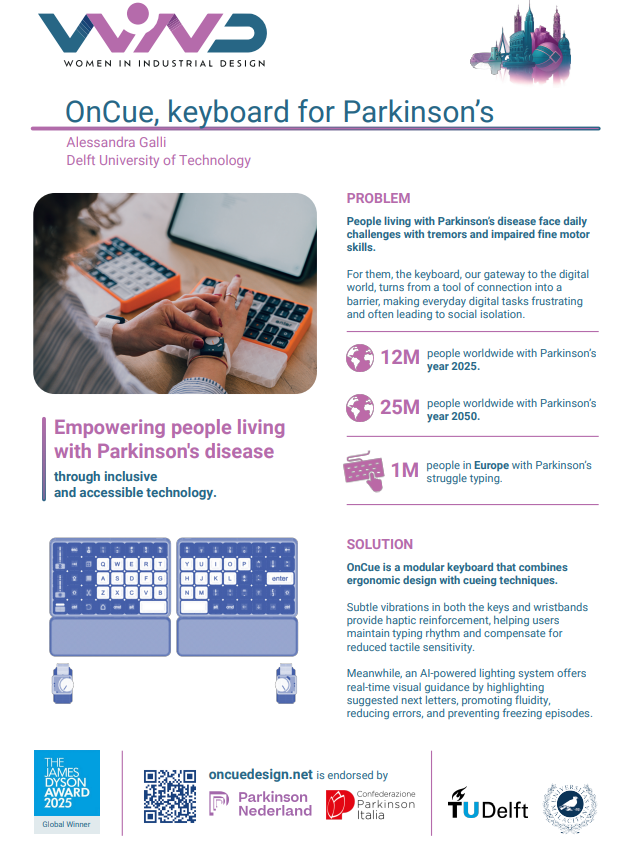
OnCue combines cutting-edge ergonomic design with “sensory stimulation” techniques to facilitate typing. Its modular structure with raised-edge keys reduces muscle fatigue and prevents accidental keystrokes caused by tremors. The system emits subtle vibrations both in the keys and in special wristbands. This helps maintain typing rhythm and compensates for reduced tactile sensitivity. An AI-powered lighting system highlights the letters the user is most likely to type next. This promotes fluency, reduces errors, and helps prevent freezing episodes.
OnCue is not just a peripheral device; it is a tool for independence. By enabling smoother digital interaction, it allows people with Parkinson’s to regain their voice in the online world, maintain social connections, and continue participating actively in society.
Take a look at the exhibition poster!
Student